
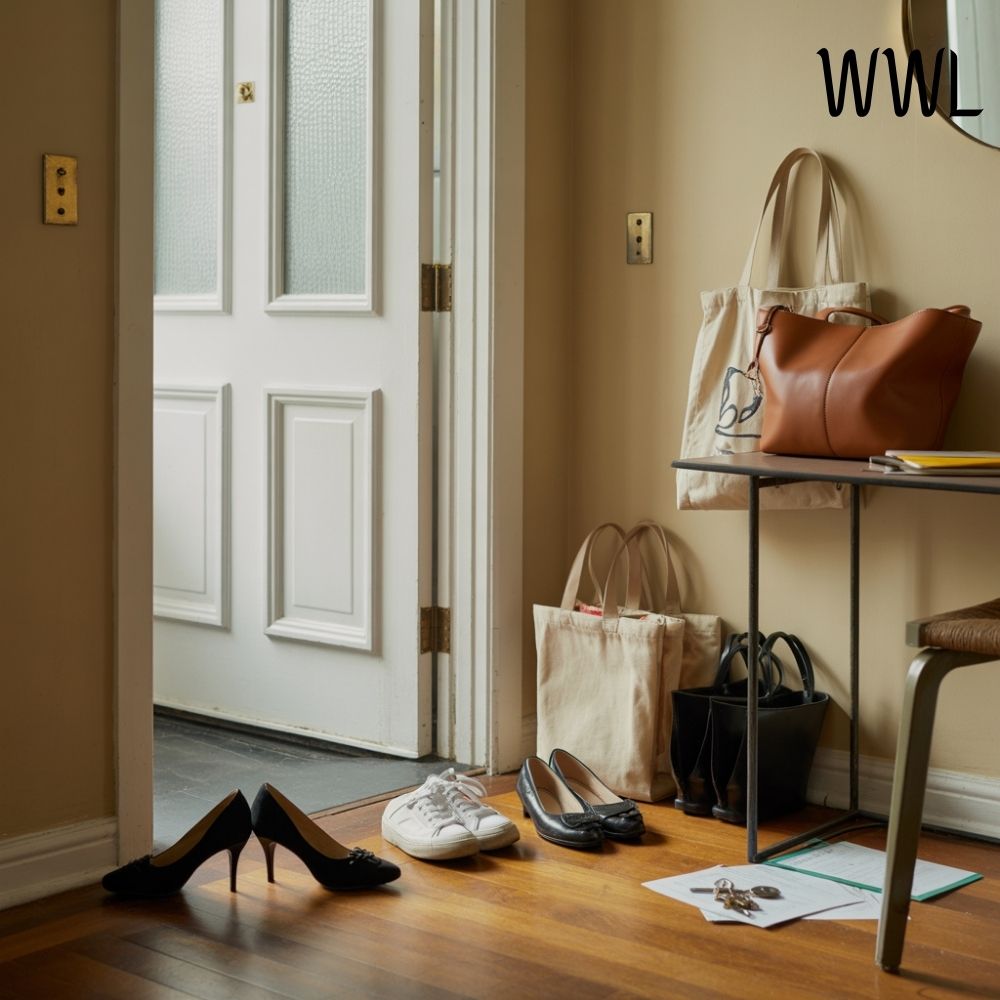
For a long time, my entryway was the one part of my home that never quite caught up to the rest of my intentions. It carried a kind of quiet disorder that I felt every time I walked through the door.
Shoes lingered just slightly out of place, keys rested wherever they landed, and bags collected along the wall as if the space had resigned itself to being transitional rather than intentional.
The moment that shifted everything came one evening when I arrived home later than usual. I placed my keys down, stepped back, and noticed how unsettled the space made me feel, even though nothing was technically wrong.
That realization stayed with me longer than I expected, because I knew instinctively that the solution wouldn’t be dramatic. It would need to be subtle, fast, and rooted in intention rather than decoration.
What followed was a five-minute DIY adjustment so simple that I almost dismissed it at first, yet the effect was immediate and lasting. The space felt calmer, more composed, and far more reflective of the way I wanted to enter and exit my home.
Why the Entryway Sets the Emotional Tone of a Home
The entryway is often treated as an afterthought, but emotionally, it carries more weight than most rooms. It is the first place you encounter when you return and the last place you pass through when you leave.
When that space feels cluttered or undefined, it creates a subtle friction that lingers, even if you cannot articulate why.
I began noticing how differently I felt walking into homes where the entryway had a sense of order and restraint. Even when the space was small, there was clarity.
Nothing competed for attention, and every object seemed to belong exactly where it was. Those homes felt composed before you even reached the living room, and that composure carried forward.
I realized that composition does not come from filling space, but from assigning purpose, and that insight became the foundation for the DIY I now rely on every single day.
The Five-Minute DIY: Creating a Defined Landing Zone
The DIY itself is deceptively simple, which is part of why it works so well. Rather than adding more storage or decorative elements, I created a single, clearly defined landing zone that quietly absorbs the small, necessary items of daily life without allowing them to spread.
I chose one surface, and only one, to act as the anchor. In my case, it was a narrow console table near the door, but the same concept works with a shelf, a bench, or even a small section of a countertop. The key is not the furniture itself, but the intention behind it.
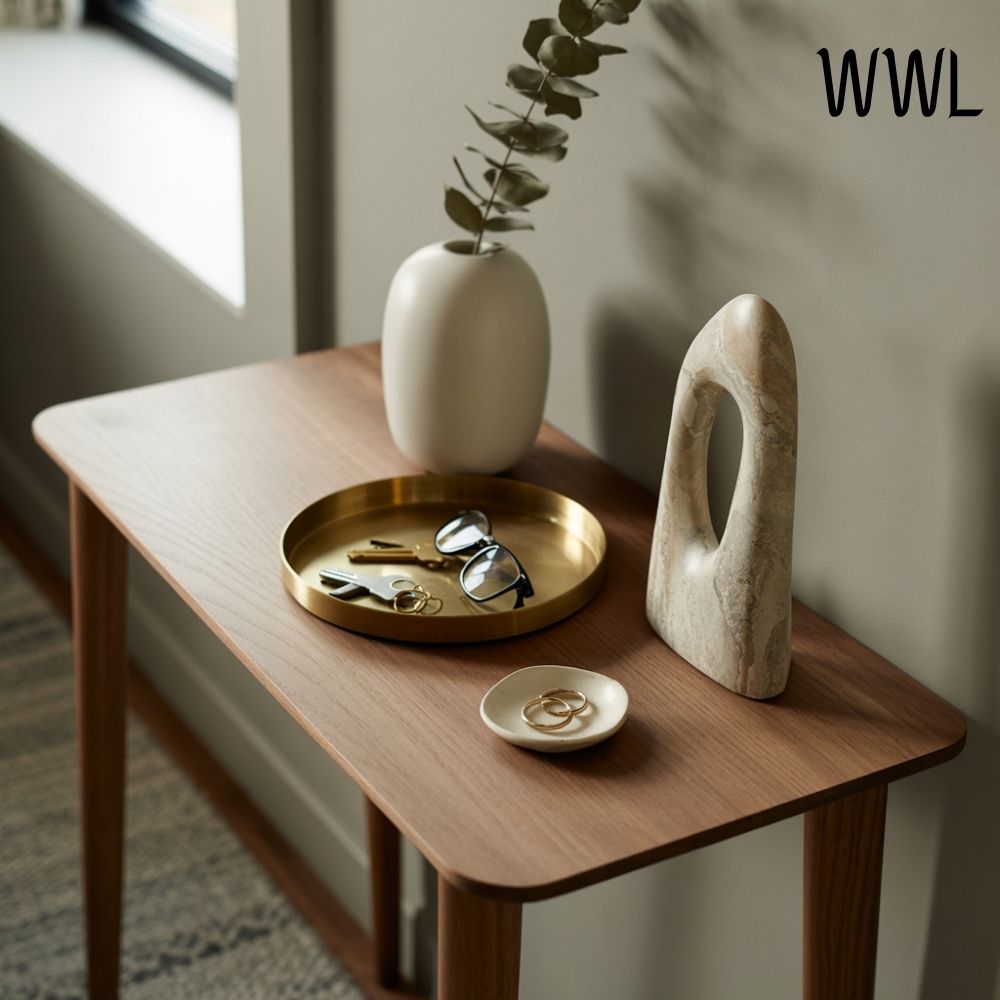
I removed everything from that surface and allowed it to sit empty for a moment. That pause mattered more than I expected, because it forced me to confront how little the space actually needed. Once it was clear, I added back only three elements, each chosen with restraint and purpose, and that was the entire DIY.
Element One: A Tray That Sets Boundaries
The first and most important element was a tray. Not a decorative one meant to be admired, but a simple, solid tray with clean lines that could visually contain the everyday items I needed close at hand.
The tray became an unspoken boundary. Keys, cards, and sunglasses now had a designated place to land, which immediately eliminated the scattered feeling that used to follow me into the house.
This single addition did more for the entryway than any storage solution I had tried before, because it worked with human behavior instead of against it.
Element Two: One Vertical Object for Balance
The second element I added was something vertical, chosen specifically to counterbalance the flatness of the tray. In my entryway, it was a simple ceramic vessel holding a single branch, but this could just as easily be a lamp, a sculptural object, or a tall container.
The purpose of this element is not decoration, but structure. Verticality gives the eye a place to rest and creates a sense of intention that immediately elevates the space. Without it, entryway surfaces tend to feel temporary, as if they are waiting to be used rather than already resolved.
What I love about this detail is how quietly it works. It doesn’t draw attention to itself, yet without it, the composition feels incomplete.
Element Three: One Item That Signals Arrival
The final element was something deeply personal but visually restrained. For me, it was a small dish I use only for my ring when I come home. That single object transformed the entryway from a pass-through into a moment of arrival.
This element is essential because it connects the space emotionally to your routine. It signals that you are no longer moving through the world, but returning to yourself. It does not need to be sentimental in an obvious way, but it should feel intentional and specific.
Once this element was in place, the entryway stopped feeling like a staging area and began feeling like a transition with meaning.
Why This DIY Works So Instantly
What makes this five-minute DIY so effective is that it does not rely on discipline. It relies on clarity. By assigning clear roles to a small number of objects, the space begins to maintain itself almost effortlessly.
I noticed immediately that I stopped dropping items elsewhere, because there was no ambiguity about where they belonged. The surface stayed clean without constant resetting, and the entire entryway felt calmer, even on busy days.
Composition creates behavior. When a space is designed with intention, it gently guides you without requiring effort, and that is the hallmark of a truly refined home.
How You Can Adapt This DIY to Your Own Space
This approach is flexible by design. Whether your entryway is large, narrow, or barely defined, the same principles apply. Choose one surface. Limit the elements. Assign purpose clearly.
The materials do not need to be expensive. The objects do not need to match perfectly. What matters is that each item earns its place and contributes to the overall balance of the space.
If you are unsure whether something belongs, remove it. If the surface still feels complete without it, you have your answer.
Final Thoughts
The five-minute DIY that transformed my entryway was not about styling or organization in the traditional sense. It was about composition, clarity, and respect for how space shapes behavior.
By defining a single landing zone with intention, I gave the entryway a role it had been missing, and the entire space responded accordingly.
This change reminded me that high-impact improvements rarely require more effort or more things. They require better decisions, made quietly and consistently.
When you approach your home with that mindset, even the smallest spaces begin to support you in ways that feel effortless and deeply reassuring.